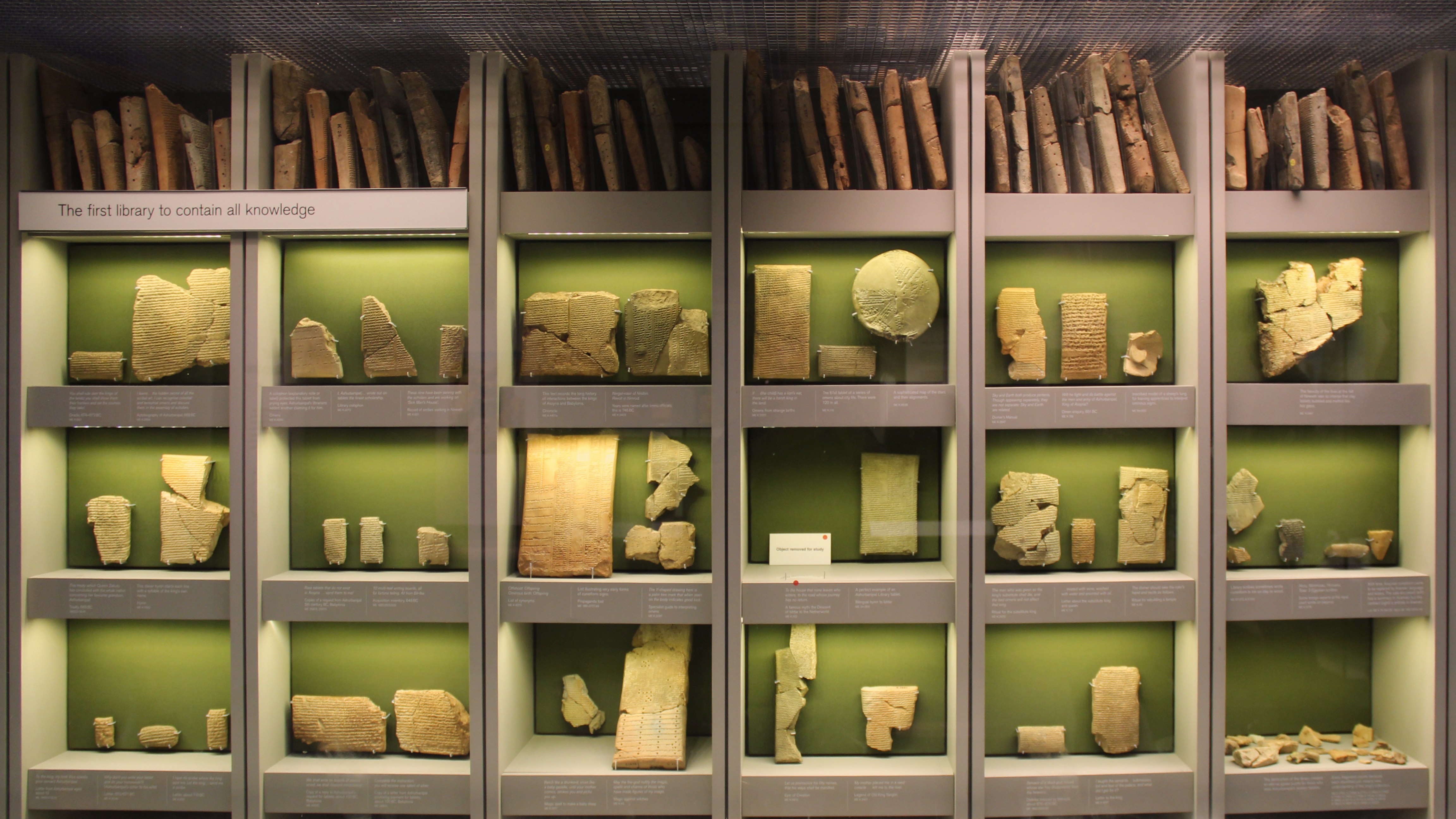
In 1849, the British archaeologist Austen Henry Layard was excavating the ruins of Nineveh — the ancient capital of the Assyrian Empire, located near modern-day Mosul in northern Iraq — when his team uncovered two rooms filled with clay tablets. Thousands of them. They had been stored in wooden shelves that had long since rotted, and the tablets lay broken and mixed together in the rubble. It took decades to transport, catalogue, and begin translating what had been found.
What Layard had discovered was the library of Ashurbanipal, the last great king of the Assyrian Empire, who reigned from approximately 668 to 627 BCE. Ashurbanipal was not merely a military ruler — he was, by the standards of his time, an unusual figure: a literate king who could read cuneiform himself, and who had deliberately assembled the most comprehensive collection of written knowledge in the ancient world.
What Was in It
The library contained texts on astronomy, mathematics, divination, mythology, law, history, and medicine. The medical collection alone runs to hundreds of tablets, including the Sakikkû (a systematic diagnostic handbook), the Uruanna (an herbal list pairing Sumerian and Akkadian plant names), and numerous formularies describing specific preparations for specific conditions.
The majority of the tablets are now held at the British Museum, where they have been studied for over 150 years. Translations and scholarship have accelerated significantly since the late twentieth century as the field of Assyriology matured and as new tools for botanical identification became available.
Why Nineveh, Specifically
The Mesopotamian medical tradition was not unique to Nineveh. Texts have been found at other Assyrian and Babylonian sites, and the tradition clearly predates Ashurbanipal's collection by a thousand years or more. So why name a supplement brand after this specific place?
The honest answer is that the library of Ashurbanipal is the primary reason we have access to this knowledge at all. Other archives were smaller, less systematically compiled, or have not survived in the same quantity. This library is where the most comprehensive medical and botanical knowledge of the ancient Near East was gathered, copied, and — by accident of archaeology — preserved.
"Nineveh was the place that kept the knowledge. Nineveh Laboratories is the attempt to do something careful and honest with what that keeping has made available to us."
What the Tablets Cannot Tell Us
It would be a mistake to read the Ashurbanipal collection as a complete record. The tablets that survived are those that happened to be in those two rooms, that happened not to be too severely damaged, and that happened to be found and preserved rather than looted or lost. There are gaps. There are tablets that have been partially translated, and others that have not yet been fully studied.
This is part of why Nineveh Laboratories is starting with three well-documented herbs rather than a larger range. The history is real. The texts are real. But the work of reading them carefully — and building on them honestly — is ongoing.